FOKKER-TEAM-SCHORNDORF
|
by the Fokker-Team-Schorndorf
|
|
|
|
|
So I started to develop a copy of the Fokker triplane in 1/6 scale with the intention of making it a radio controlled model that should be build as close to the original as possible. After finishing the fuselage of the model in 1:6 scale, I decided to start working on the full size aircraft with the wings. |
|
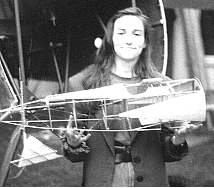
It was nothing but pure luck that I decided to do a reconstruction of this Fokker triplane. During construction of the wing ribs I noted soon that the triplane provided a very big advantage compared to other aircraft. All three wings carried the same airfoil and there was no tapering of the wings at all along the whole wingspan. In fact that meant that I only needed to construct one master piece. Since only about 60 wing ribs would be needed, this circumstance appreciated very much. |
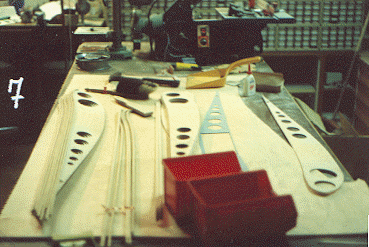
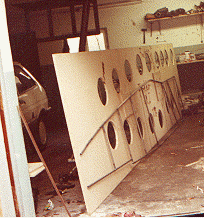
The outer shape of the airfoil was transferred to large sized plates of ply-wood. These sheets have been produced of Finnish birch aircraft plywood and their dimensions have been 1,5 m times 1,5 m. The ribs have been drawn onto the sheets in a way that allowed to use most of the material. One of these large ply-wood sheets with the ribs drawn onto was laid upon two other sheets that have been left blank. The whole thing was secured against slipping away by clamps. Then I used a pad saw to cut out the raw ribs. These ribs have been collected in groups of ten and were cut together to final shape and at least also got sanded. The result was the base work pieces for the further construction of the ribs. To be honest, the very first ribs were cut each one by one using a carpet cutter. This was very exhaustive and time consuming, so this more reliable method was adobted. |
|
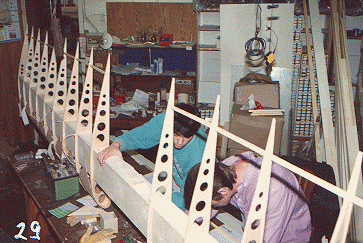
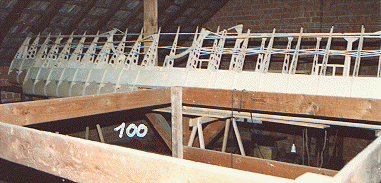
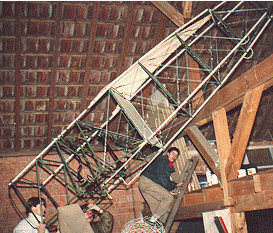
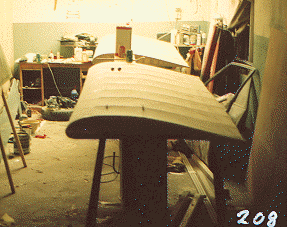
The next thing I had to do was the finishing of the rib cap strips from strips of 9mm x 6mm of fir. On their 9mm width side the strips got a 3mm deep groove. The width of the groove was wide enough to let the plywood of the ribs go in. These cap strips have been pushed onto the outer edges of the rib sheets and have been fixed by glue. After they dried the lightening holes of each single rib have been cut out using a hole saw. What was still missing was the strenghtening stripes of plywood glued to the sides of the rib sheets as well as the cut out for the wing main spar and the rear spar. Now the ribs were finished as raw pieces. I now threw my attention to the production of the wing spars of the aircarft. Each spar consisted of four flanges made from spruce. The thickness of these flanges does not change throughout the whole wingspan while their width reduced towards the wingtips. Two of these flanges have been put together by means of 1,5 mm thick ply-wood sheets to form a box spar with a height of 97mm from top to bottom. At first one of these ply-wood covers was nailed and glued to the flanges. At the locations where the wing fittings had to be, special filling pieces of wood have been glued into the box spar before it was closed on the other side. These filling pieces prevent the sheets of plywood from being pressed together by the force of the screws to secure the fittings. Following this box spar was closed by the second sheet of 1,5mm thick ply-wood on the opposite side. Two of these box spars have been put together again using 1,5mm thick plywood sheets on top and bottom to achieve a single box-type wing spar with outer dimensions of 100mm x 200mm. During this procedure also only one side was closed while the other side was left open. In regular distance there have been glued special bulkheads inside to the wingspar to prevent it from being twisted by the forces in the air. The design of all three main spars was the same. The only difference laid in the wingspan and the design of the fittings. All three wings have been constructed in the backroom of my fathers electronics shop in Schorndorf. There we established some kind of little workshop. Of course, the conditions at least have been some kind of hazardous. But it did work! The wing spars themselves have been very long, but not that cumbersome. This changed in the moment I started to pull the ribs onto them. The depth of the wing is 1000mm. The lower wing was the first to be done. The ribs have been pulled onto and the small supporting spar at the end of the wing was pulled in. The connection between the ribs and the main wingspar was provided by simple three angular pieces of spruce that have been tacked and glued to both sides of the rib ply on the spar. At the sides of the rib web these pieces covered the full depth between the upper and lower rib flanges. At the top side of the spar and at the underside these three angular spruce pieces were only 40mm long and have been located at the back side of the wing spar only. Father and son Engels are working together on the triplanes lower wing. Clearly in evidence is the lack of space available at that time. The structure of all three pairs of wings is the same. After the lower wing was finished as a raw piece and all upcoming problems have been sattled, it was relatively easy to assemble the remaining two wings. What still provided difficulties to me was the lack of space available whithin our small "workshop". To proceed with the assembly of the middle and the upper wing we had to find a place to store the lower wing in the meantime. It was considered the best to hang the wing from the ceiling to get it out of way. I did the same with the middle wing when completed. Only while assembling the upper wing further minor difficulties rose up: the wing span of more than 7 metres. Now we had to use the full diagonal line of the room to get the wing finished. Step by step the wings of one of the most famous fighter aircraft of the First World War grew up in the back room of my fathers electronics shop. It was for sure somehow some kind of a magnificent feeling to see something old grow up new. The euphoria became bigger and bigger with every single part that was added to the project. Slowly but steady below our hands an aircraft was put together. The dream that raised within my young heart some years ago now in the truest sence of the word got wings. At last the nose covering of 1,2 mm thick ply wood had to be pulled onto the wing ribs. With this the wings nearly have been finished. All over Schorndorf I could not find a reliable garage or small workshop where I could carry on with the work. The only room that I found was a part of a old barn we rented for 150.- German Marks per months. This room whithin the barn was an open one and was located some 5 meters above the floor level with a space of 7,5m x 4m. Above all in the center of this place a hole measuring 2m x 2m for an old not working elevator was situated. The only securing from falling down was provided by a fence of simple wood boards. There I now had to put the wings, since they hindered the work in the "workshop" by their size immensely. Through a window in the back of my fathers shop the wings were brought out one by one. Following this they have been put onto the rooftop of an old Ford Fiesta. With walking speed we carried them the way to the barn which was three miles away in town. Carefully we brought them upstairs where they awaited their covering with linen fabric.
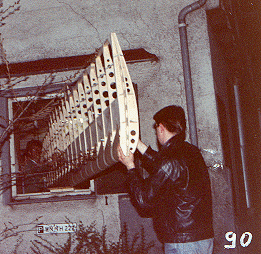
Wolfgang Schuster and Mathias Dobler are bringing one of the wings outside through one of the windows.
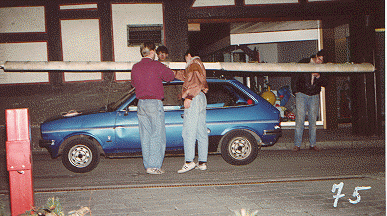
From left to right: Harald Fischer, Wolfgang Schuster, Achim Engels and Mathias Dobler. The lower wing is bound down onto the deck of the Ford Fiesta.
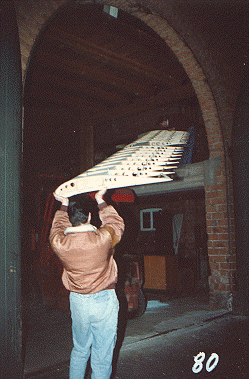
Achim Engels And Harald Fischer are bringing the Lower Wing upstairs.
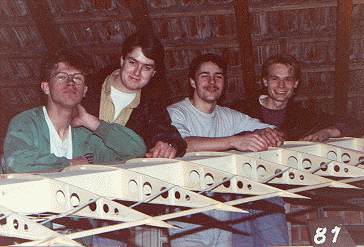
At least it was done! From left to right: Wolfgang Schuster, Mathias Dobler, Achim Engels, Harald Fischer. Whithout the help of these friends of mine I would not have been able to carry on some times.
The three wings under the rooftop of the barn awaiting their covering. Meanwhile the work proceeded at the "workshop". Since the triplane used in large numbers steel tubing construction that was welded, we now had to familiarize with that kind of work. Again the clever books have been consulted. But there is a long way from theory to earning practical useful skills. Of course, my first welding trials could rather more be compared with the work of "roasting jack" then with good welded seams, but I managed to handle it. The first part I dared to construct was the triplanes rudder. Work went well ahead and the result was a beautiful comma shaped rudder. Shortly afterwards the ailerons followed, then the stabilizer and the elevator. These parts also have been stored away inside the barn.
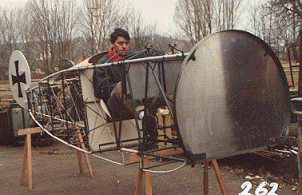
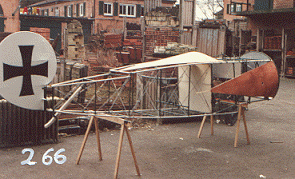
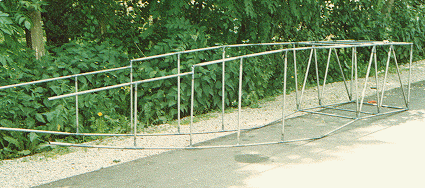
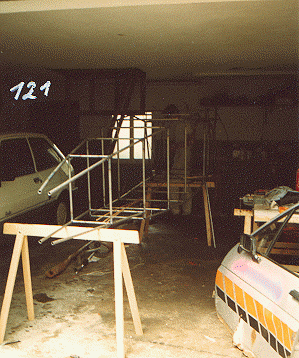
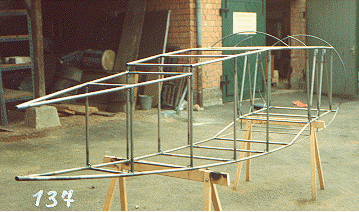
The simple jig to allow welding of the fuselage side parts. The raw tobular steel tube frame of the triplanes fuselage.
The garage of Wolfgang Schuster`s family became the welding workshop. Now heavy work was to be done, since the steel tubings of the fuselage structure had to fit exactly one to another to allow a good welding result. To achieve this, I used simple rasps and files and worked on each tube by hand until it did fit. The welding job was done in the jig which was a simple self made wooden construction to hold all the tubes in place. A regular heating of the tubes whithin the structure is important since the whole structure would otherwise get twisted. The working on the fuselage frame was carried out in the garage of Wolfgang Schuster`s home. The whole fuselage frame was covered by a protective coating followed by olive green colour after the welding job was done. This again happened at the barn together with all other steel tubing components that have been finished earlier. At all the locations where later the fabric covering should be fixed, the tubes have been wrapped by 30mm wide stripes of linen fabric. To this wrapping later the covering could be glued and sewed. Meanwhile the space available at the barn was almost filled up by aircraft components. One could hardly turn around anymore.
The finished raw
fuselage right in front of the barn.
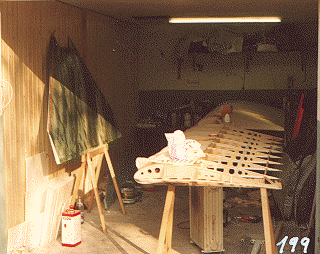
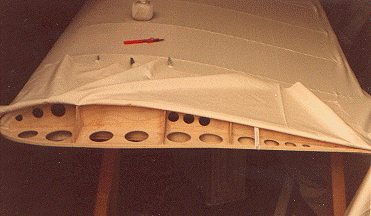
The finished fuselage being brought down from the rooftop of the barn to start covering. The covering procedure was first tried by using small self built wooden frames and after this went well, I started to cover the smaller surfaces such as rudder elevator and ailerons. All covering works have been carried out inside of Wolfgang Schuster`s garage again. Following these smaller parts I also brought the lower wing to the garage and started covering it. This also went well without any problems. The most time-consuming process while covering was the sewing of the fabric onto the ribs. To allow the fabric to be sewn to the ribs they have first been covered with farbric that was laid upon the flanges and glued to the rib web. Unfortunately we have not been able to cover the middle and the lower wing in the garage, too. The garage was simply not long enough. Allready while covering the lower, no single sheet of paper fitted between the wing tip and the closed door. For this reason I covered them at the barn. The fuselage again was covered inside the Garage.
The lower wing just
befor beeing covered inside the garage.
The linen fabric beeing pulled onto.
The ready covered lower wing.
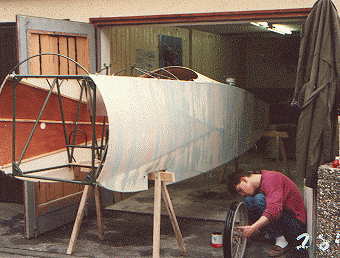
The now covered fuselage inside of the garage. Wolfgang Schuster is working on one of the wheels mentioned in the text. Now we proceeded with the construction of the landing gear. There have been difficulties with the aquiring of the streamlined steel tubes needed to go ahead. The material came from the U.S., since there was no company found that produces such tubes here in Germany. I did not want to make it myself at that time, nor did I know at that time how to do it. It would have been possible, but also rather complicated. The wheels turned out from alone. Within the barn where the aircraft parts have been stored, we found a old fire car. It`s wheels have had exactly the same shape we needed. Diameter, dimensions, number of spokes, shape, everything was a perfect match - the only misfortune was the profile on the tires.
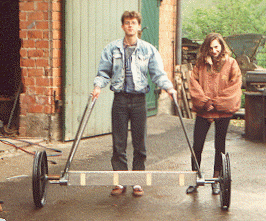
Wolfgang Schuster and Renate Engels showing the raw finished undercarriage. There they stood now really finished. The single construction units of my first reconstructed aircraft - the Fokker Dr.I. The date of finishing and the time of beeing shiped to the museum at Speyer also approached unstoppable. Up to this point, I simply had to hope that all parts would fit together since we worked according to my own drawings. For this reason we decided to assemble the aircraft at least one time for a final testing. Following some considerations we decided to build the aircraft up in the backyard of Wolfgang Schuster`s home. The assembling of the aircraft almost went as well as the construction itself.
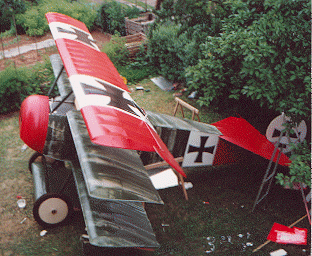
The triplane in the backyard of the Schuster family.
View across the triplanes "business-office". Approximately one week long the aircraft stood there in the backyard. Guarded day and night by us - there below the Mirabelle tree. It is important to mention the Mirabelle tree and it should not be overlooked, since during that week several reporters of different newspapers came to interview us. And each one of this reporters mentioned the Mirabelle tree in his report. All the same kind of school! The aircraft became the sensation at all and we hardly could finish the work in time giving all the interviews requested. But by anything that tried to keep us away from finishing work we did it right in time and prepared the aircraft for its transport to the museum. The day came and at one evening also the truck of the museum. With a heavy heart we brought the plane onto the truck. First the wings, then the stabilizer and rudder as well as the elevator. At last the fuselage. It was raining that evening. The truck dissapeared and with it my "child", my childhood dream. Two weeks later we also drove to the museum to assemble the aircraft there.
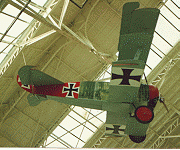
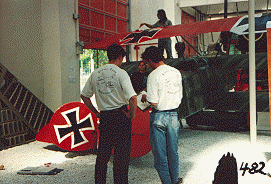
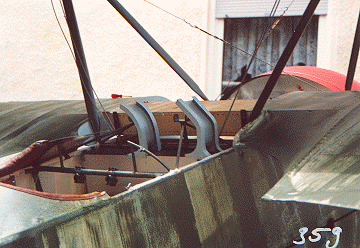
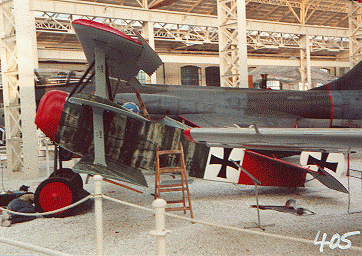
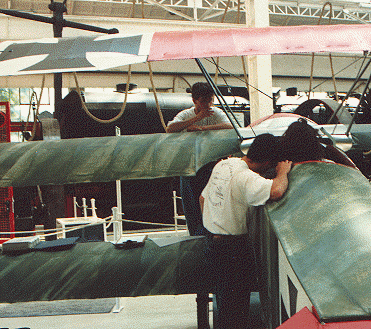
The aircraft shortly after its arrival at the museum. What still was missing was the engine and the propeller. These parts we should deliver as reproduction dummy parts as well. One more time we spent a visit to Speyer to make last modifications on the paintings and markings. The same time we painted all of the serial numbers into the right places.
Last changes. From
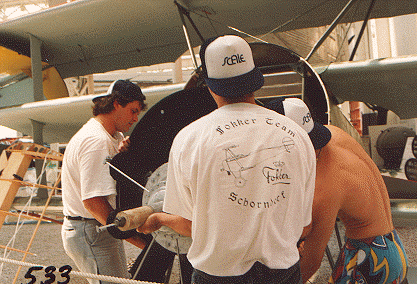
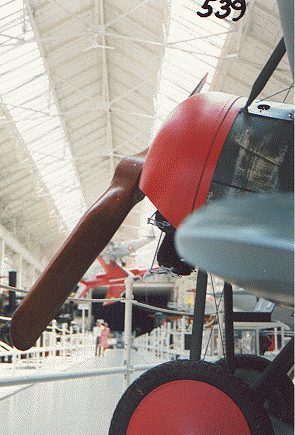
left to right: Wolfgang Schuster, Achim Engels. Soon afterwards the dummy propeller and engine also have been finished and could be installed by us. By now the completely finished Fokker triplane hangs from the ceiling of the museum.
Bernd Gaab
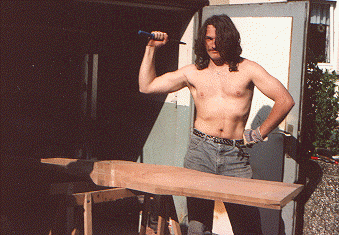
displaying supperiority over the wood.
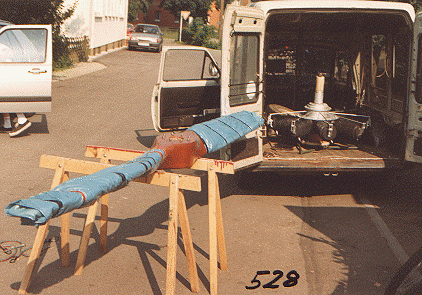
The Propeller and Dummy engine are finished and prepared for their transfer to the museum at Speyer on a saturday morning.
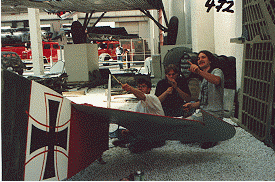
The final finishing at Speyer. From left to right: Steffen Krauter, Achim Engels, Wolfgang Schuster. We consider this first static reconstruction of the Fokker triplane by the Fokker-Team-Schorndorf as beeing the first step into the right direction of providing a basis for discussion. Based on the earned knowledge I will evaluate errors and mistakes, to assure the historical knowledge will be saved for future generations in the correct way. For sure there have been made mistakes during the course of reconstruction, but wherever possible they have been corrected. For sure our construction drawings are allways kept up to date, corrected and improved. I judge my work from the point of view of the historian and in no other way. I am not simply interested in producing reproduction aircraft as usual today, but I am rather more endeavoured to base my documents upon historically authentic sources. The triplane constructed by the Fokker-Team-Schorndorf is only the beginning. Further projects will follow for sure, and again we rely on the help of anybody who might be interested in the matter. You can allways donate historical documents and photographs related to German aviation technology up to 1920 to the archive of the Fokker-Team-Schorndorf. The product of long and hard work. It was fun! One last word. The above text was written in German language in 1999. In case you are interested in further details about what was achived in the meantime, check out my homepage at go to the AeroForum at http://www.worldwar1aeroplanesinc.org/forums/forumdisplay.php?s=33ad8b854d84c56f0589cf1f41946039&f=97 or check out my facebook photo album collection at http://www.facebook.com/profile.php?id=100000456879188&v=photos I am looking for a financial partner who would like to support my plan of establishing a unique flying museum, since I am reaching my financial limits! Spread the word, please |
Copyright © 1990-2000 A.S.Engels; historical documents and photographs are free.. | HOME | CONTENTS | LINKS |FEEDBACK | |